
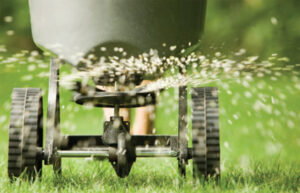
Broadleaf Perennial Weed Control – Regular summer rainfall and multiple bursts of extreme temperatures provided a perfect storm of opportunity for annual and perennial weeds to thrive and flourish. Now, as temperatures wind down and the days shorten, is the ideal time to manage them. For widespread weed problems, a blanket lawn application of selective broadleaf herbicide may be needed; for lighter infestations, spot treatment should be enough. Liquid applications are more effective than granular “weed & feeds” and are available in ready to spray, hose-end sprayers and concentrates. If you need to do an entire lawn treatment, we offer liquid drop spreaders with hourly and overnight rental options. Treating perennial weeds now helps prevent next spring’s dandelions, plantain, clover, and other broadleaf pests. If you plan to seed this fall, apply liquid herbicide first, wait two weeks, and then seed. Apply only when no rain is expected for at least 12 hours and wait 24 hours before mowing.
If you don’t get rid of the weeds this fall, your lawn will surely regret it next spring.
Fertilizing in the Early Fall – Cool season lawns should be fed twice in the fall to promote root growth, deep green color and improved turf density. This early fall feeding is very important in that it’ll help promote new growth from the crowns of summer stressed turf to thicken up the lawn. Our controlled release, natural-based granular fertilizer can be done in conjunction with the weed control applications or fall overseeding.
Seeding in September and October – Most of us will need to do at least some seeding this fall due to damage and thinning form summer conditions. Cool season turf thrives in the “cool seasons “. It is our very strong opinion that everyone who cares about their lawn and wants a nice lawn should do at least SOME SEEDING EVERY FALL. Now is also the time to upgrade old, tired lawns and thicken up thin, shady areas. Fall is by far the best (really the only) time of the year for seeding lawns. The ground stays warm and as we get deeper into the fall, the nighttime temperatures will be perfect for all cool-season grass, from seedlings to established lawns. Roots grow well and deeper in warm soils, while the cool night air along with anticipated regular rainfall is perfect for germinating seeds. When seeding, if we don’t get enough regular rainfall, supplemental watering will help speed along the seed germination and establishment. And as the newly seeded areas germinate and begin to establish, carefully evaluate mowing the new lawn. As you would mow your existing lawn, mow high (at leat3.5” inches) and regularly being careful to cut the new grass only when it is dry, or you may damage it.
Liming and/or Core Aerating in the Fall – We recommend that all lawns be limed and core aerated every year in order to help stimulate deeper and denser root systems. Liming can be done at any time of the year (other than when snow’s flying) with our Enhanced Lime (a high efficiency lime) with Humic Acid and beneficial Biologicals. It’s applied in an easy to handle, pelletized form, which will raise soil pH in weeks instead of months! As mentioned above, core aeration (the pulling of soil cores from the lawn) helps break up the heavy, dense soil so root systems get bigger and reach deeper into the soil. Core aeration is also the best way to prepare for fall seeding. By opening up the soil with thousands of pockets for seed and water to collect in, it’s the most effective way to produce a thicker, healthier lawn next spring. So, either do this yourselves or give us a call and have our Turf Management group, with their “best equipment available” do the job for you.
Checking Lawns for Grub Damage – This is the time that grub damage starts to become evident. If you didn’t apply preventative grub control this year, and some areas of your lawn that haven’t greened back up along with the rest of the lawn, you’ll want to check for grubs. Take a stiff rake to any brown patches and scratch vigorously and if the turf rolls back easily, exposing ½” long, off-white semi-circular worms in the soil… well, then you’ve got a grub problem. Eradicate them by applying granular BIO-ADVANCED’s 24 Hour (DYLOX) Grub Killer and water in thoroughly and then, as soon as possible, reseed the damaged areas.